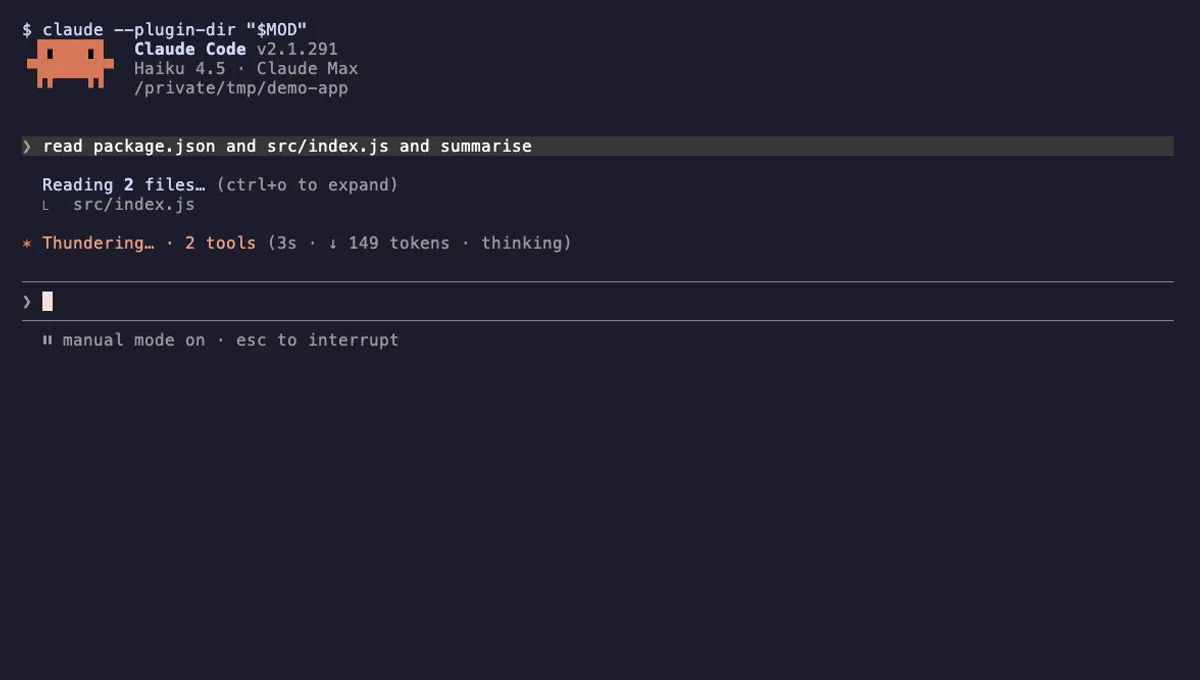
Tool Call Counter
Counts Claude's tool calls per turn and session, shows the count by the spinner, and adds /tally for a breakdown.
- spinner
- transcript
- status
- Intercepts tool calls
- Changes the UI
- Adds commands/tools
tested with v2.1.291
Claude Code slash command mods add commands like /tally that answer instantly in code, with no model call, or change how built-in commands behave.
Counts Claude's tool calls per turn and session, shows the count by the spinner, and adds /tally for a breakdown.
tested with v2.1.291
Claude Code slash command mods add commands you type in the prompt, such as /tally or /diff, and answer them in code. Because the handler runs inside Claude Code, it can reply instantly from data the mod has collected, open a pane, or change a setting, with no request to the model and no tokens used.
A mod calls $.command.register({ name, description }), usually in its session.start hook, and then handles command.run with a matcher for that name: on('command.run', { command: 'tally' }, ...). The handler returns { text } to print a reply, which renders as Markdown in the transcript, or {} to finish silently. Command names allow letters, digits, _ and -, up to 64 characters.
The same command.run event also fires for every other command, so a mod can wrap built-in commands. command.describe lets a mod change how commands appear in the command list, and $.command.run lets one mod invoke another command. The create guide walks through a /tally example.
A command mod shows Adds commands/tools. That badge on its own is low risk: the command only runs when you type it. What matters is what the command does when it runs, so read the rest of the badges. A command that reads mod state and prints a table needs nothing else. One that opens a pane adds Changes the UI. One that runs git, reads files or calls a server shows Runs commands, Reads files or Network.
Also check for name clashes. Two mods can try to register the same command name; prefer mods that use a specific name and say so on their page.
Use a mod command when the answer is mechanical: counting, listing, toggling a setting, opening a view. Use a regular command file or a skill when you want Claude to think about the answer. Many useful mods combine both, collecting data in hooks and reporting it through one command.